Homework
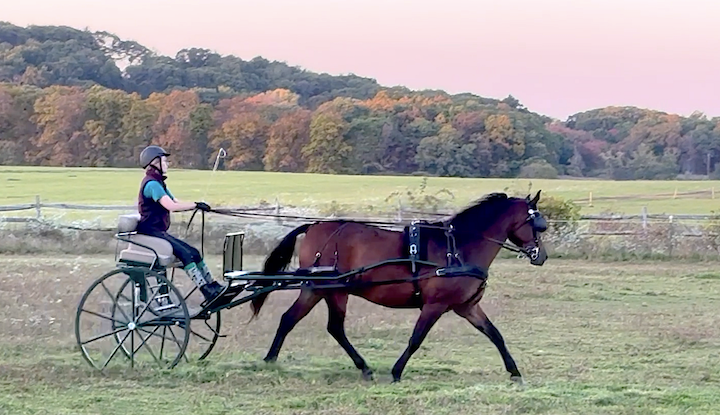
When baby horses grow up and start flexing their skills, the real fun begins. Last time, I promised a post on trailer loading, and I will deliver, but lately Mother Nature has given us several weeks of glorious weather for riding and driving. I would rather not spare the footage in favor of more boring fundamentals. I've tucked away my trailer loading post for a future rainy day. For now, this post will feature some of the most beautiful (in my opinion) images and videos we have ever taken, so please enjoy the pure splendor of our adventures in New England.
Once Levi's new driving bridle arrived (which is beautiful by the way - thank you to Mindy and Chimacum Tack!), I wasted no time in putting him right back to work in his cart. Despite training intensely under saddle this summer while we put driving on hold for a bit, he behaved and moved beautifully, as though he never took a day off, and my confidence in his training soared. The riding "module" put the afterburners on the pony and I am glad for it, because it has made a huge difference in both his fitness and his way of going. Lately, we are working on lengthening the stride at both a trot and canter, getting a nicely forward canter (hello hills!), and hacking out in the wide world instead of doing mostly arena work up to this point. So far he is earning an A+. Of course, this should surprise no one, as he is a little over-achiever.
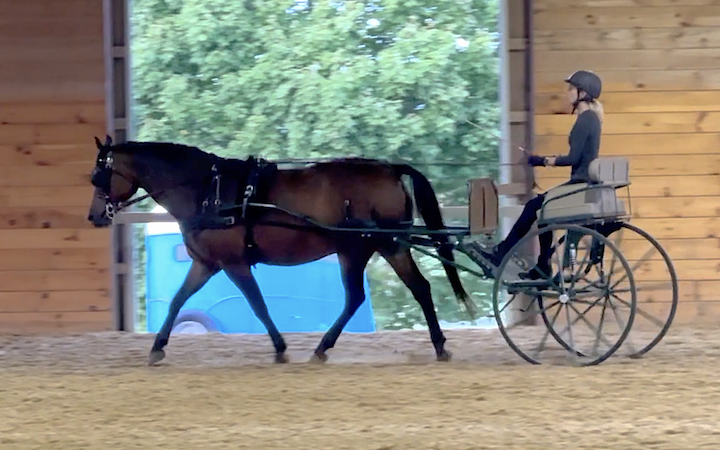
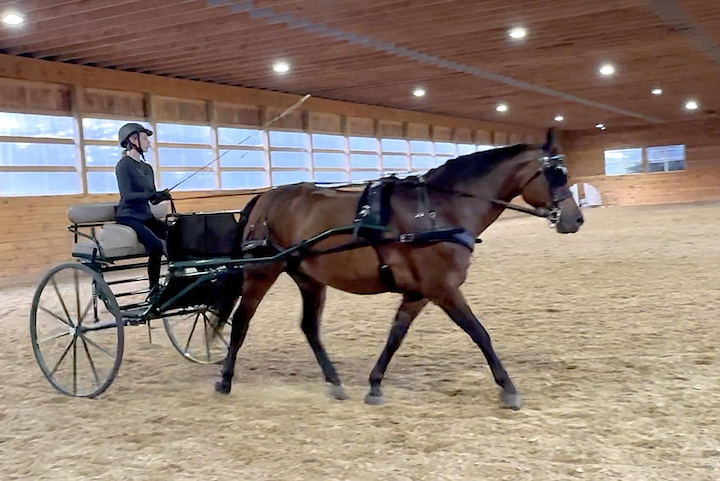
Stills from our first drive after 8 weeks of purely ridden training. I saw and felt: a more 'together' frame, better quality of movement, and more impulsion. Training the driving horse to ride with dressage as the main discipline is doing wonders for him.
To lengthen the stride, I had a few dumb ideas. If something is dumb but it works, is it dumb? I'll leave that up to you to decide. Like everything, I try to introduce or teach movement I want from the ground first. One of the poignant phrases my instructor has impressed on me is this: "You can only influence the hind leg when it is in the air!" With that in mind, I used my longer driving whip to just barely touch that inside hind on the stifle, first at a trot on a 20 -30 m circle on the lunge line, and then at the canter. The idea was to first just ask him to think about that inside hind leg and remember that he has one he can utilize. I practiced this also under saddle, using a longer dressage whip while still maintaining contact. We worked on this in the indoor arena first, then outside. The second dumb idea I had, which I have shared before, is to use hills to approach upward transitions particularly for the canter; the uphill puts the horse in the ideal frame for the canter because his croup is lower than his withers, and he can easily lift his shoulder to power up. He lifts more of his weight behind, and the rider can more easily get out of his way. Since he naturally wants to burninate up hills, asking for the upward transition at the right time makes the cue easier to understand and gives him the right feeling in his body for it, when we go back to riding on the flat. Trotting downhill is also good for helping lengthen the stride and I like to help him find his own balance while again staying centered and out of the way. Our stride lengthening workouts, dumb as they may be, have made a big difference for Levi in his impulsion and forwardness at a canter. The workout is simple in its format: we hack out for two miles at a brisk walk (with some trotting on the flat trail to get him used to when I will ask for this in the future), and when we return to the trailhead we take advantage of a nice long hill with a relatively slow burn and steeper crest. We do no more than 3-5 repeats of cantering up this hill with walking downhill, and then head back to the outdoor arena where I warm down at a trot for about 10 minutes. He's pretty toasted after this, but the benefits of banking this workout as a once or twice per week investment has made a big difference for him.
Due to his prior training, Levi happily goes out by himself or with other horses; in the video below, which is now my very favorite of all time, he and Mozart are practicing their little canters and it sparks joy. We were so happy to be cheerleaders for Mozart, whose confidence with his canter work is increasing. Being a calm, confident, and steady horse, Levi has a calming effect on more nervous horses, and is a great trail buddy for that reason. When I watch this little video, the song from the animated 1973 Disney film "Robin Hood" comes flying out of the memory vault: Robin Hood and Little John, walking through the forest, laughin' back and forth at what the other has to say...
Go Levi! Go Mozart! Good boys earning their wings on the trail.
Under cart, the same idea applies: get out of the arena and into the world. During our first outing back (shown in the videos below) I had no doubt that Levi is at heart a combined driving horse, and we will continue with our training plans in that direction. On the day this video was filmed, we were attacked by mosquitos, and poor Joe my camera man didn't heed my advice to spray himself down before heading out there. I'm happy he managed to stick around long enough to take these gorgeous videos!
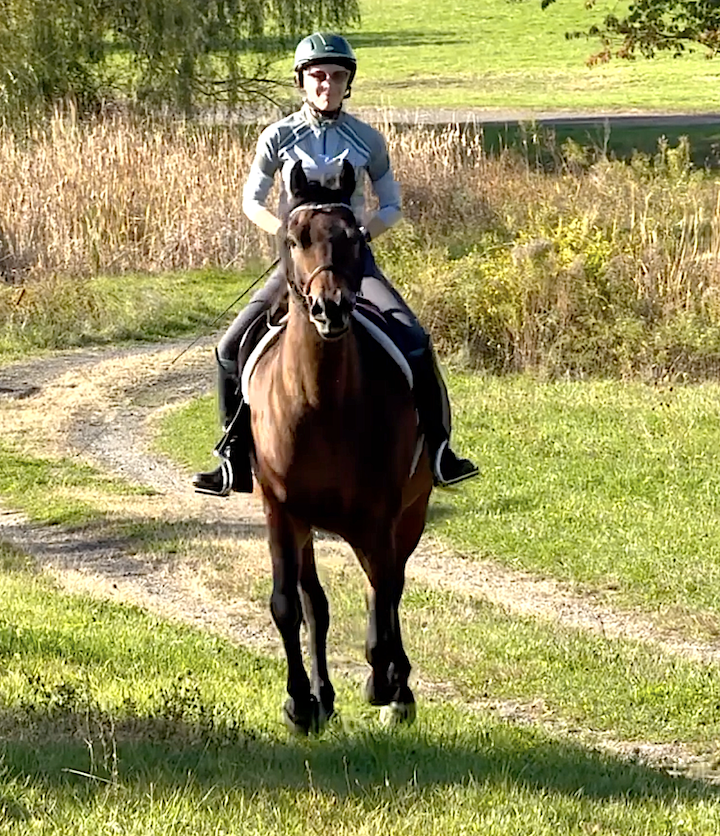
Under saddle, I've slowly asked for more forward canter. The hills really help here and he is starting to ignite when asked; I loved these final repeats from last week's workout. The fact you can see my smile from space is all you need to know. I'm not a daredevil or anything, but when we achieve liftoff I can't help but wonder if there's maybe an eventer in there somewhere - it's probably not a good idea to teach your carriage driving horse to jump.
Putting the afterburners on the pony.
Well, that's it for now, but I will continue to share our progress this Fall, and as we enter cooler weather we will begin our most excitingly boring project yet - teaching obstacles and cones in the cart outdoors.
Member discussion